New General And Another Great Program

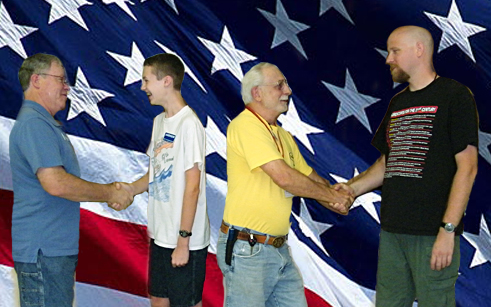
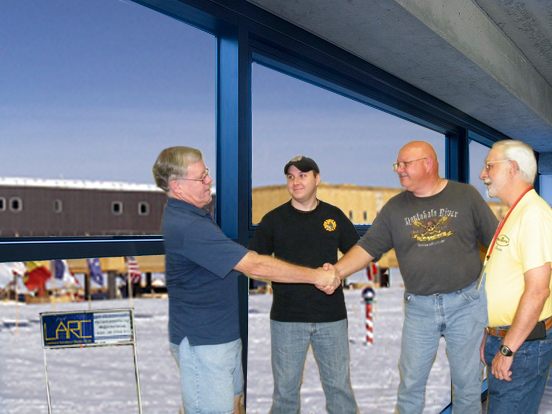
Christopher Costine, K4CLC, earned his General License this evening.
He is pictured here shaking hands with Patrick KI4CDY, with his son Chris Jr looking on. Ernie KG4YNI is on the right. Thanks to Christopher, the club now has a presence at the South Pole. Also present but not shown were VE’s Mike KT2T, George KI4NBE, and Bill KI4ZMV.
Patrick addressed several items of interest before the main speaker. These included the following.

                          

  1. A 40 cup coffee pot was purchased for the clubs use during meetings and events.
  2. The Kathleen Historical Society will hold its annual fall event Nov 3. Club representation this year  has not been confirmed. If you would like to man a booth for the club, please contact Rip AA4HT aa4ht@tampabay.rr.com
  3. The Boy Scouts of America are looking for support for Lake Wales Jamboree. Please contact Charlie, KI4CRI for more information.   ki4cri@arrl.net  
  4. MARS is looking for new members. Patrick has more information if you are interested.
  5. There will be Sky Warn classes held at Lake Alford November 8th from 7 to 9pm.
  6. The Christmas party will be held Monday, Dec 17. The cost will be same as last year, $9.00 per person, and deserts are welcome. Note, the Christmas party will take the place of the monthly meeting for December.
  7. We will be collecting food for VISTE at the November meeting. Peanut butter and tuna fish are good suggestions if you wish to participate, and clean plastic bags are always appreciated.
  8. The board is actively pursuing the interests of the club’s younger members and will form a committee seeking their suggestions.
  9. Roger and Ren reported on the need for candidates for one or possibly two positions on the board. If you are interested in serving on the board, contact either Roger or Ren.
  10. The speaker at next month’s meeting will be Mike Sinclair from Microsoft. More on this to follow.
  11. Tom Evans took names for a course on digital electronics that he plans to teach to club members next year. If you are interested, but were not present, you can contact Tom on Yahoo Groups.

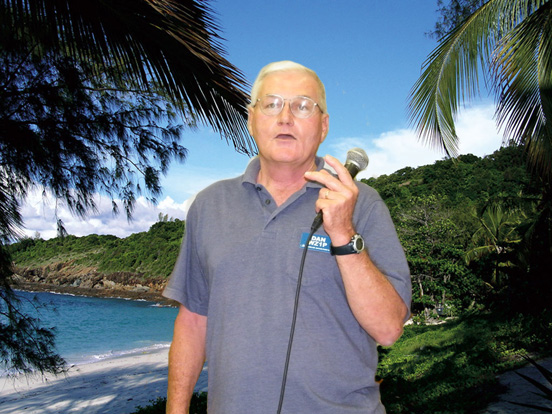
The main speaker for the evening was Dan who presented a program on Dxpeditions, or what you can do at a reasonable cost, and with fifty pounds of gear, on an exotic island. The next scheduled trip is to Barbados Jan 29th to Feb 6th, and is already booked solid.


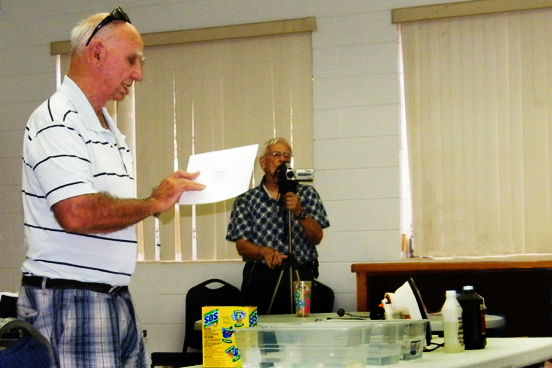
At the end of his presentation, several interested hams gathered round to see what fifty pounds of gear looks like.


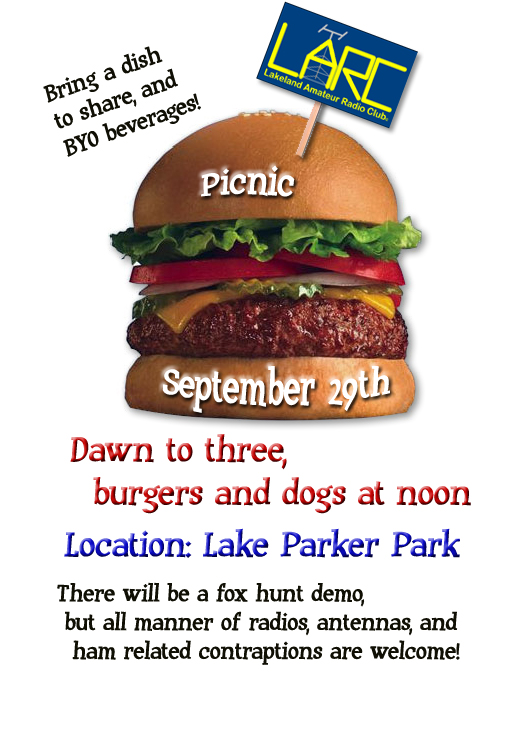
Picnic On The 29th, 2012!

For directions to Lake Parker Park click here.
We will be monitoring our repeater for assistance.
For More Information please contact Patrick at ki4cdy@arrl.net

*burger appearance may vary. Offer not good where prohibited by diet. Always contact your doctor before engaging in any serious eating event. If you experience drowsiness lasting for more than four hours you should seek professional help.

Labor Day Meeting, A Labor Of Love

Radio interference is a very sensitive issue for anyone having to deal with it. When the club got an email from Cecil Erdly asking for help with a radio interference problem, Ernie KG4YNI was first to respond. He offered several suggestions, and by the time Bill KI4ZMV contacted him, Cecil he had the problem narrowed down to one specific street lamp, and even supplied the light’s pole number.

Fortunately for hams, and non-hams alike, we have Mark KJ4IRD. Mark works for the Lakeland Electric Company. One of his responsibilities is tracking down and remediating electrical interference that may be related to the power company. From the information I relayed to him by phone, he was able to dispatch a crew to the area and replace the offending lamp in a matter of hours. Great work Mark! Problem solved.

I was very curious why Cecil would contact the Lakeland Amateur Radio Club for help with radio interference. Cecil was kind enough to come to our meeting and share his story with us. He explained that when he was a youngster, he made the acquaintance of an older gentleman on his paper route. This man happened to be a ham radio operator, and like most hams, was happy to take the time to explain what the hobby is all about. Cecil was impressed with the fact that this man was knowledgeable enough to build his own radios. This must have made quite an impression on Cecil, because fifty years later, when he asked himself who would know about radio interference, ham radio operators came to mind first. For a Radio Club whose mission is Service, Education, and Comradary, I can’t think of a better complement.

Cecil is pictured here with an image of the radio he used to listen to as a child. Cecil, you are welcome to drop by any time. 
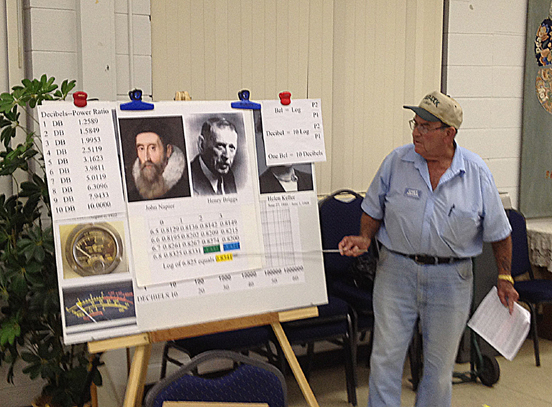
The main speaker for this evening was Chet AB4XK, who delivered his well-polished presentation on decibels. He included many historical facts, and some humorous bending of others. Did young Alexander’s dad really call him young Aleck as a toddler and later smart Aleck as a teen? 🙂

Chet’s presentation was not only historical. It also covered the utility as well as the math associated with decibels. Some knowledge of logarithms is required to fully understand the concept and Chet was kind enough to review those dreaded logarithms we had to deal with in high school. These days we find logs on calculators, but back then, the closest thing to a calculator was a slide rule.

During his presentation Chet made clear the importance of logarithms when it comes to representing large numbers. It is a lot easier to represent something as 26, than as the number 1 with 26 zeros after it. In addition to their ability to represent large numbers, logarithms are particularly useful for representing the intensity of sounds and brightness of light. The human ear and eye respond logarithmically. That is, the log of the intensity of sounds and brightness of levels of light appear to us more evenly spaced. It is the way we are built. Our sensors are not linear.

Keep in mind that decibels are logs of power ratios, or Power out divided by power in. Chet made clear that 3 db, or 0.3 bells represents a doubling or halving of power or intensity. Photo buffs, familiar with adjustable f-stops and shutter speeds deal with this all the time. It turns out that f-stops represent log intensity changes of 0.3. If you halve the exposure time, you must open the lens one stop to maintain the same exposure. If you double the exposure time, you must close the lens down one stop.

One might be tempted to suggest that S-units are in increments of 3 decibels also, but we would be wrong if we did. In terms of power, each S-unit represents a 6 db, not 3db power change. (There are reasons for this. It is on the extra exam.)

Chet’s presentation contained many excellent visuals. One in particular was a chart depicting the relationship between frequency and reactance. Though mostly obsolete, now that we have calculators and spreadsheets, it is still helpful for getting a ballpark idea of the levels of capacitance and inductance needed to achieve resonance at a given frequency. Get your copy here.

Here is Chet, delivering his presentation to a captivated audience, which included three teen hams who now have an even better understanding of why we need to study all that math in school. It is so we can become better ham radio operators! 🙂

New Tech

Congratulations go out to Darren Matteson on passing the Technician’s test, and with nearly a perfect score!

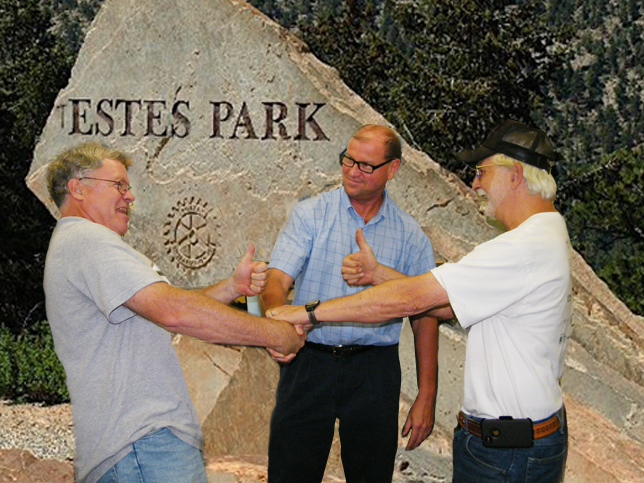
Darren is on his way to Colorado, and we wanted to make him comfortable before his arrival, so we placed him there in the photo. That cool dry crisp air will be a welcome change from the high temps and humidity of Florida.

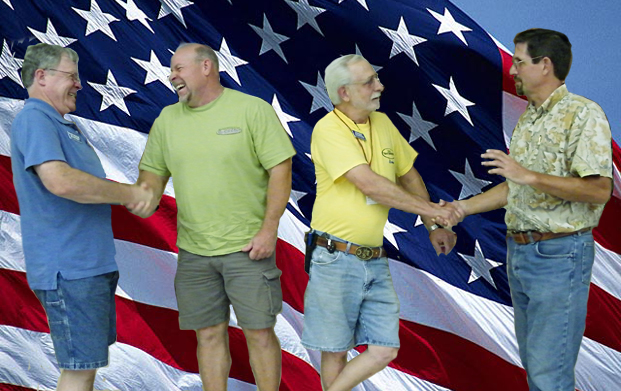
Left to right, club president Patrick KI4CDY,  Darren Matteson, and former club president Ernie KG4YNI. Also present, but not shown was VE Bill KI4ZMV.

Peggy Lang Passes Her Tech

After joining us for field day with her close friend Rich N4ESS, Peggy thought to herself, “this looks like fun. I’ll bet I can do this.” After studying for the test, and getting a good deal of help from friend and Elmer Rich, she proved she could. In fact, she did very well on the test. I wouldn’t be surprised to see Peggy and Rich in the near future when she takes her General.
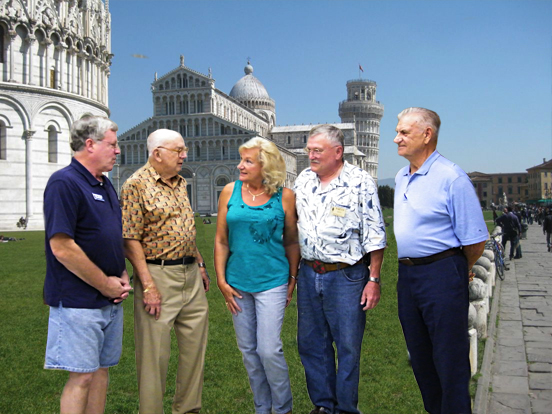
Left to right Club President Patrick KI4CDY, Al W4ZSC, Peggy Lang, Rich N4ESS, and Bert KG2G. Also present for the testing but not shown were VEs Bill KI4ZMV, Mike KT2T, and George KI4NBE.

Extra Today, Boot Camp Tomorrow

Natalie KK4KEG has been working hard. During our field day session she passed her Tech. Then, before our last club meeting she walked away with her General. Saturday, in a special VE session, she passed her Extra!

You might say that Natasha is a girl on a mission. She left for Fort Jackson SC Sunday. After boot camp she will go to school to learn Mandarin. Natasha is already somewhat of a polyglot having mastered both Russian and French, in addition to her native English. I am sure the military intends to make good use of her linguistic talent in the not to distant future. We wish her well.
Left to right: Patrick KI4CDY club president, Natasha KK4KEG, and Ernie KG4YNI, former club president. Also present, VE Bill KI4ZMV.
Oh, and the machine shop? This is where Ernie turns out parts, and occasionally, when needed, hams. J

WB8VLR Is Now An SK

RUTH HODAPP

RUTH

HODAPP, 66

Parole Officer

LAKELAND – Ruth Hodapp, 66, died July 24, 2012 of multiple sclerosis.

She was born in Red Wing, Minnesota. She worked for Polk County Government as a parole officer.

She is survived by her husband, Herman Hodapp, a son, Herman Hodapp, Jr., her mother, Betty Sutton, grandson, Michael “Dent” Hodapp and step-sister, Virginia Sutton.

A service will be held Saturday, July 28, 2012 at 10:00 am at St. Josephs Church.

Condolences may be sent to the family at http://www.heathfuneralchapel.com/.

Ruth was a former club member WB8VLR.

Field Day Wrap Up from Fred K1DU

Field Day 2012
I just want to take a moment and thank every one for their efforts this field day. I could not believe the amount of people that took part in the event. As I had mentioned at the club meeting field day started as a way to bring out your radios and antennas and test them in the field in case of emergency, and as the ARRL says it is the biggest operating event of the year. Yes it is a contest, but a friendly one to test your skills in setting up your equipment and operating and the points they are a measurement of how well the club did in those category’s. I dare anyone to tell me when Dec. QST arrives with the field day results that you don’t go with club pride to see how well we did, nothing wrong with that, that’s part of field day. You know, its not the only part of field though, its getting together and learning new things,its teaching new hams the hobby, its having young hams make their first contact, its about testing new hams so they can join our ranks, its about learning new modes of operating, its about making new friends, its about getting reacquainted with older friends, its about letting other people and agency’s know who we are and what we are about, its about sitting down and having real fine meal together and last but not least its about getting to know each other a little better which makes our club a nice to be. YES YOU DID ALL OF THE ABOVE! And you should be real proud of it ! I know I am !

Good Job Everyone !!!

Contacts and Points:
Our best year was in 2010 with 649 contacts and 3,268 points and this year we just blew that away. With 1,137 contacts and 4,394 points and that was despite tropical storm Debbie ! Which shows we can function in adverse conditions.

Special Thanks:
Bill Busbin KF4Q for bringing out his trailer and beam and taking it down in the rain and for also helping Ansel make his first hf contact. that was amateur radio at its best!

Rip AA4HT for sending out all those messages on cw for extra points.

George Mann KJ4UW for doing all the public relations and invitations to officials and there were many.

Tom Evans KJ4WFS and Mike Oliver KT2T Tom for setting up a nice looking and running station and contest operating skills as well as Mike and his operating skills. For showing everyone how its done. 600 contacts! WOW! also for helping a lot of new hams make their first contact.

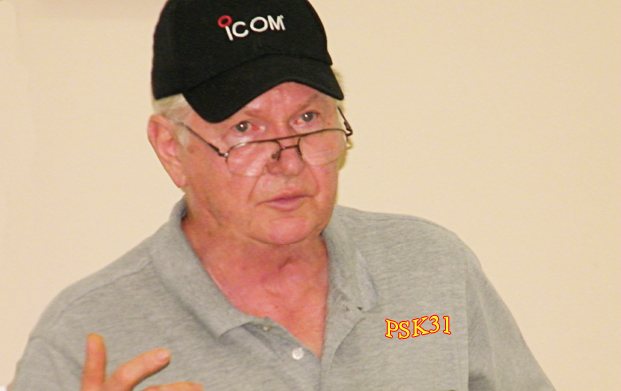
Gary Lee KS4JI for his fine demonstration of PSK-31 .I would like to run that station next year.

Robin Retzloff AF1RE for his fine demonstration of satellites and I hope he will try again next year.

George Gafford KI4NBE for the fine Job he did on the 40 meter phone station.

Rip AA4HT and Bob Foxworth K2EUH for putting in extra long hours on the cw station because we were short handed.

Patrick O Neil KI4CDY a special thanks for heading up the food this year the meals were real good and to Ren Monllor KG4BAS for helping him.

I wish to thank everyone that helped set up and tear down and brought batteries , coax or rope the outpouring of help was enormous, truly a fine club effort and it made my job easy. As I mentioned, you should all be real proud of yourselves!!!

73,
Fred K1DU

Don Does Etchings

What better way to celebrate Independence Day than by getting that Amateur Radio license. It is the only passport you will need to travel to any country over the airwaves.

First the new Techs.


Left to right, club president Patrick, new Tech Andrew Stevens, Former club president Ernie, and new Tech Darrin Heard

Next we have three new Generals.

Once again left to right, Patrick congratulates Mike Martin KK4JTB and Ernie congratulates Dr. Ron Case. Ron passed both the Tech and General in one sitting. Great job! Not pictured, Natalia KK4KEG, also passed her General. In Natalia’s case you might say that makes two Generals in the same family. 🙂

After a few timely comments from Patrick, Gary took the floor, as is our custom, with some interesting facts about amateur radio, and a few test questions from one of the Amateur Radio exams.


Seen here, Gary counts off some of the many famous people whose lives were changed by becoming Hams.


Next, Fred shared some field day numbers with those present. We did good! Much better than last year, in no small part due to many helping hams supplying equipment as well as expertise. Look for Fred to give a full report in an upcoming blog.


Finally,
the main event of the evening,
Don Jeering’s presentation on “Making Your Own Circuit boards.”

Don started with a brief introduction to the process, and gave some suggestions on producing the art work for the circuit board you want to produce. The success of this process is very dependent on your choice of paper.


Here don shows the paper that worked best for him, Staples Photo Paper.


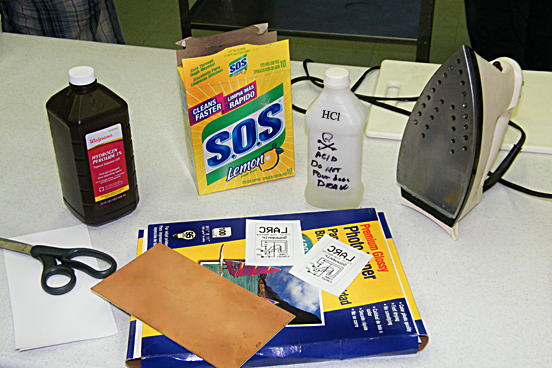
Before we go any further you should be aware that the artwork has to be reversed, or flopped, as a printer might say. Also, this process works only with toner type printers. It will not work with ink jet printers. Lastly, it is absolutely important that the blank copper clad board be clean. This is accomplished by scrubbing a blank board with an SOS pad.

After printing the artwork with a laser printer it is cut to the size of the board you will use.


Don is shown here cutting the image of the circuit to the size of the circuit board he will make.

Next, the photo copy must be transferred to the board. This is done through the application of heat.

Here Don demonstrates how to “iron and press” the photo copy in order to transfer the laser printers toner to the board.

After ironing and pressing Don soaked the board in plain water to soften the paper. Then, very carefully he pealed the paper away, leaving only the toner image on the board. Because the original was wrong reading or flopped, the image transferred to the board is now right reading.

The next step is etching. Before we can etch we have to mix two chemicals that will become our enchant. The first is ordinary Hydrogen peroxide, the second is hydrochloric acid. Both are readily available. You can find the acid in pool supplies, and the peroxide in the pharmacy section. Always add acid to water, never the other way round. Also, wear eye protection, work in a well ventilated area, and wear gloves. Safety first. OK, with all that in mind you will want to mix the peroxide and acid in the ratio of two parts peroxide to one part acid.

With chemicals mixed we are ready to etch the board. All the copper not covered by the toner image will be dissolved away, leaving a board ready for drilling and mounting parts.

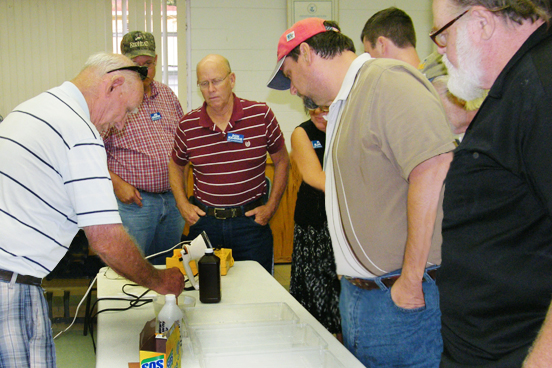
Here Don shows his etchings to some onlookers.

Finally, here is everything you need to make your own circuit boards, with the possible exception of a very tolerant wife.