The Citrus Tour May 5th and 6th 2018 The main speaker for this evening was Mike Breese, W2YS. Mike made a request for help with this event. Several positions need to be filled. Radio operators are required at each rest station. Operators with vehicles capable of transporting bike and biker are also needed. Finally, operators are needed at command center. Dinner will be held for participants. More information is available at http://www.citrustour.org. Our club contacts for this event are Bob Doherty, or for the skinny from the man who has done this the last ten years running, Larry Walker, KI4DNO. You an contact Larry at KI4DNO@aol.com. Darrell Davis KT4WX recently appointed Mike Bresse W2YS as an Assistant Section Manager for the Special Project of the Bike MS Citrus Tour. Bresse is the new amateur radio coordinator for the Bike MS Citrus Tour starting this year and had previously been the SAG vehicle coordinator for a number of years.
National Hurricane Awareness Week May 6 to 12
Mark your calendars for Friday May 11 for the 2018 Hurricane Awareness Tour to be held at the Lakeland Linder Regional Airport, 3900 Don Emerson Dr, lakeland, FL 33811. Admission is free.
Things To Do:
- Tour Hurricane Hunter aircraft
- Meet the pilots & flight crew
- Speak with hurricane forecasters
- Meet with local National Weather Service meteorologists
- Walk through exhibits from various agencies & organizations
- Learn about weather safety & preparedness
For more information visit https://www.weather.gov/tbw/hat
March Of Dimes Event Coming April 2018

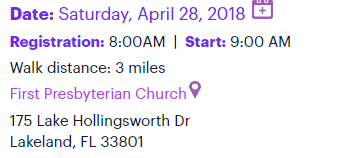
March of Dimes – March for Babies 2018 – Lakeland March
LARC has, once again this year, been chosen to provide communication support for the Lakeland portion of this national event. Volunteer Radio Operators are needed from 7:30 AM until 10:30 AM.
Please bring your HT. We will be using the LARC repeater at 146.685 PL 127.3. The event will once again be held at the First Presbyterian Church. We need a total of 10 volunteers to fulfill the needs of the event.
Please email Bob Doherty ( KM4BAO) at KM4BAO@yahoo.com to sign up. A detailed email will then be sent to all volunteers.
Thank you in advance for volunteering!
Were You On the Thursday Night Net 4/26/18?
The weather has been great, and I can see why many of us may not want to be indoors on such beautiful nights, but even if you don’t have the time to spend listening to the entire net, you can always check in as a short timer and then be on your way. Of course, you are always welcome to hang around and listen. You never know what might come up.
The following were on the net this Thursday. I have included as an experiment the distance each person lives from our repeater. Yes, that 49 mile contact was from Hudson FL. Mack reached us with a Yagi mounted on a 47 foot tower. His signal was full quieting.
| Call | First | Last | Distance |
| KI4ZMV | Bill | Johnson | 4.6 |
| WZ1P | Daniel | Gagnon | 4.12 |
| W7STR | Rush | Springer | 4.54 |
| KG4PWF | Jim | Scott | 1.66 |
| N7CUC | Sam | Shaver | 2.88 |
| N4HES | Arthur | Hess | 8.45 |
| WX4AMS | Andrew | Stevens | 7.81 |
| KN4CHP | James | Edmonson | 6.1 |
| W4MAC | Mack | Walls | 49.3 |
Some interesting stats about the Blog
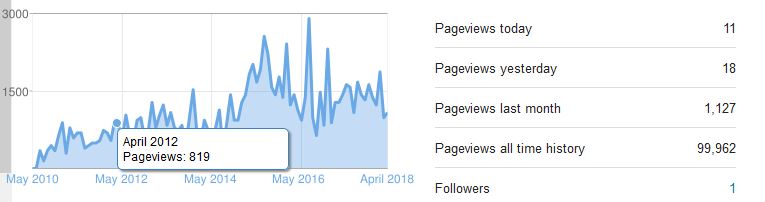
So who is looking at our blog? You don’t suppose there is a Putin connection here, do you? 🙂
|
Entry |
Pageviews |
|---|---|
| United States | 73193 |
| Russia | 7063 |
| South Korea | 2719 |
| Ukraine | 2610 |
| Germany | 2059 |
| France | 1359 |
| Poland | 650 |
| Brazil | 630 |
| Malaysia | 493 |
| Ireland |
325
|
Are You Average?
The average is computed by adding up all the values in a set and then dividing the total by the number of values. Aside from the definition, the word average is has other connotations. We say that he has average looks, or he is an average athlete. Well, I wondered where the average club member lives. So, for all club members with a Florida address, excluding those who have a PO Box, I looked up their Latitude and Longitude. Calculated the average. Then, I searched Google Maps for the average latitude and longitude of LARC club members. The result was interesting.
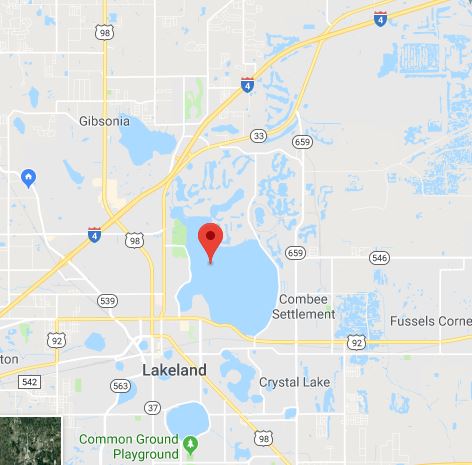
The average LARC member lives in Lake Parker! How should we interpret this? Does this suggest that as far a housing goes, the average member is underwater? That sounds a bit fishy. Perhaps there is something mystical about this location? Like the Bermuda Triangle, with Comradary, Training, and Service all coming together. Might there be some strange power drawing us to this site?
Averages have their place and are useful, but shouldn’t be taken too literally. If you are told that the average family has two and a third children, you are not bothered by the fact that you have never seen a third of child, or for that matter, question which two thirds are missing. Yet it somehow seems fitting that on average member of the Lakeland Amateur Radio Club lives in a lake. 🙂
A Reminder About The Club’s New Email Server
This originally came from Mike Oliver. Please, if you have not already done so, visit the listserver-jolly.dreamhost site and sign up. The procedure is quite simple. After you have done this you will begin to receive the kind of group mail you were used to getting from Yahoo groups. You will also be able to send group mail.
Due to the plethora of problems experienced in recent months with the Yahoo groups infrastructure, a mailing list has been setup to facilitate the LARC membership communication which will replace this Yahoo group in the coming months. It is highly recommended that you visit this page to subscribe:
http://listserver-jolly.dreamhost.com/listinfo.cgi/cq-lakelandarc.org
All of the information about the list is on that page, including the new email address to which you’ll send messages to reach the other list members <cq@lists.lakelandarc.org>. Please take a few minutes today and subscribe to this list.
A Handy Tool To Locate Repeaters and Hams
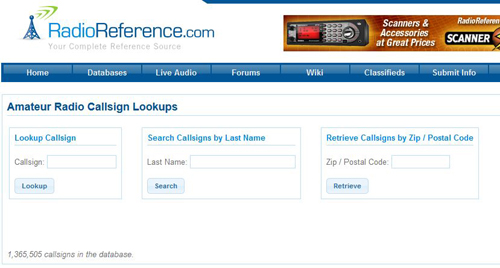
Sooner or later every new ham is going to ask, what repeaters are available in my county, and who are the fellow hams who live near me in my zip code? These are two questions easily answered using a handy link on our blog. You can find it by scrolling down the right sidebar until you see Helpful Links.
Click on the second entry, Frequency Lookup Ham and Non Ham.
From the main menu of Radio Reference.com, click on Database, then from the pull down menu, select Frequency Database. We can look at the Amateur Radio Database later.
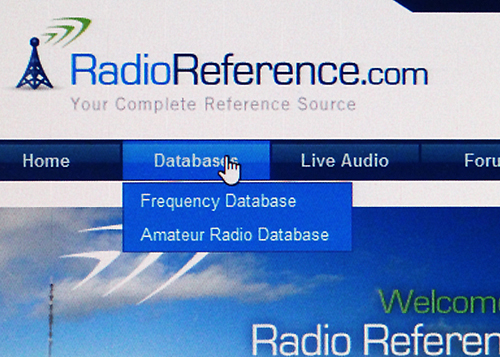
After clicking on Frequency Database you will be presented with a map of the United States. For this example, click on Florida, and then on Polk County.
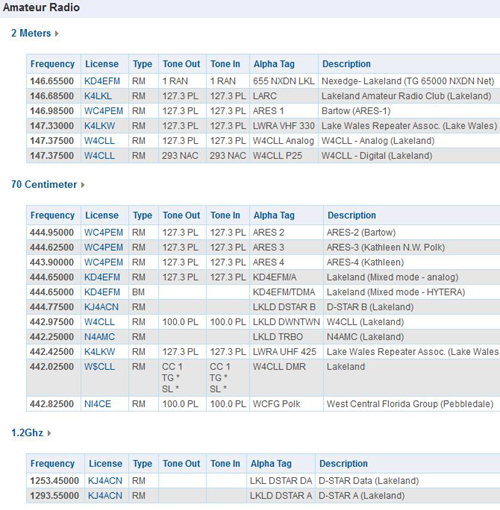
Next click on Amateur Radio on the second level menu. This will present you with a list of all the repeaters in Polk County. 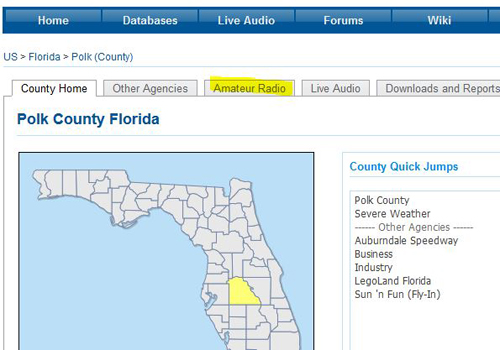
If you scroll to the bottom of the page you will find a list of all the zip codes in Polk County. Clicking on any one zip code will display a list of all hams in your zip.
Now, for the option I said I would get back to, namely Amateur Radio, which we first encountered under All Databases on the main menu. Selecting Amateur Radio will allow you to look up any ham by call sign or last name. Like QRZ, registration is required for more detail.
I hope you have found this helpful. And, if you get the chance, please thank George Mann for pointing this site out to me. 73 Bill
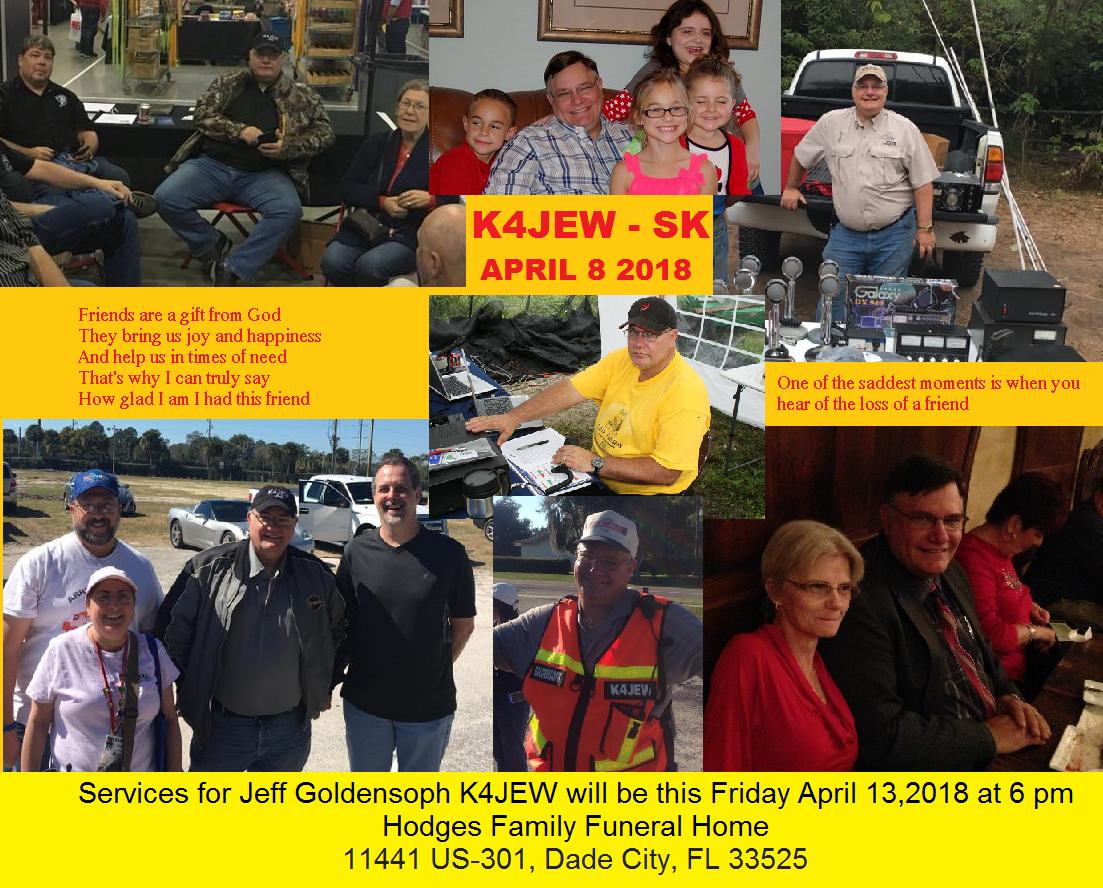
Jeff Goldensoph K4JEW Has Become a Silent Key
Services for Jeff Goldensoph K4JEW
This Friday 6 pm at Hodges Family Funeral Home11441 us 301 Dade City , Fl 33525
After services there will be a small gathering at his sister’s House on Beth Road just north of the funeral home.
LARC Members Are Invited To Come Early To Meetings!
Coffee will be brewing when you arrive!
This is a great opportunity to get to know one another.
It is also a great opportunity for show and tell if you have
something of interest you would like to share.
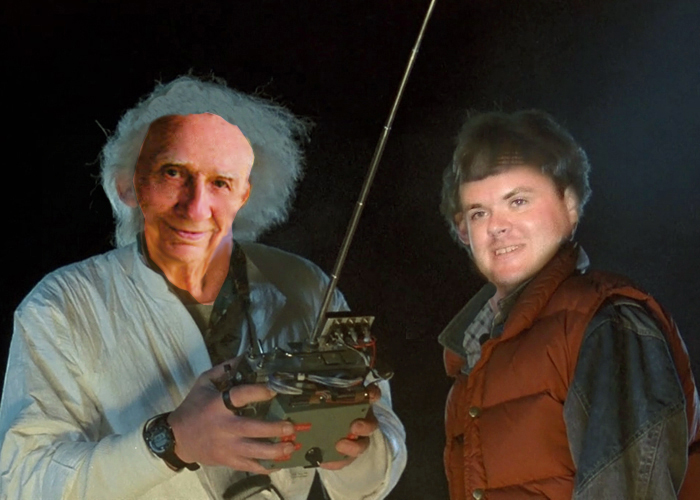 |
| It all started with the flux capacitor! |
 |
| That was then. |
Barcodes and Ham Radio
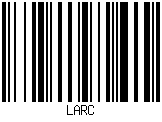
Codes are everywhere. Until humans acquire the Vulcan skill of mind melding, codes are the only communication game in town. If you are reading these words you are deciphering a code. Language written and spoken is just one of many codes we come in contact with every day.
As Hams we are all familiar with Morse Code. As consumers we are familiar with bar codes. They are everywhere, including our club’s attendance sheet. It may surprise you to learn that the idea of bar codes was inspired by the Morse Code. Its inventor Norman ‘Joe’ Woodland, while vacationing on Miami Beach, had occasion to drag his fingers through the sand while pondering a better way to check groceries out of a supermarket. He noticed that some of the lines left by his fingers were fatter than others, and spaces also varied. This reminded him of the Morse Code he learned as a Bot Scout. This was in the mid fifties, however. His concept was way ahead of its time. Intense light sources like lasers had not been invented, and computers were the size of houses and hardly powerful enough to do what simple microprocessors are capable of today. Technology advanced and by 1974 the first bar code, as we know it today, was scanned at a supermarket checkout. It was on a pack of Wrigley’s chewing gum. That item was chosen to demonstrate that this technology could be placed on the smallest of packages.
The real power of the bar code comes when it is linked to a database of related information. Each product you purchase in the store has a bar code containing a unique number. That number is associated with the product’s name, its price at that store, and if it is taxable. Once the product is scanned at the checkout, it is removed from inventory, and is tallied up until it reaches the reorder set point. At that point, more product is ordered from the vendor. You can imagine how this automation saves time. Of course, it does not eliminate human intervention altogether. It is quite possible for product to leave the store without the benefit of scanning. This is caught by physical inventory, and in some cases store greeters. 🙂
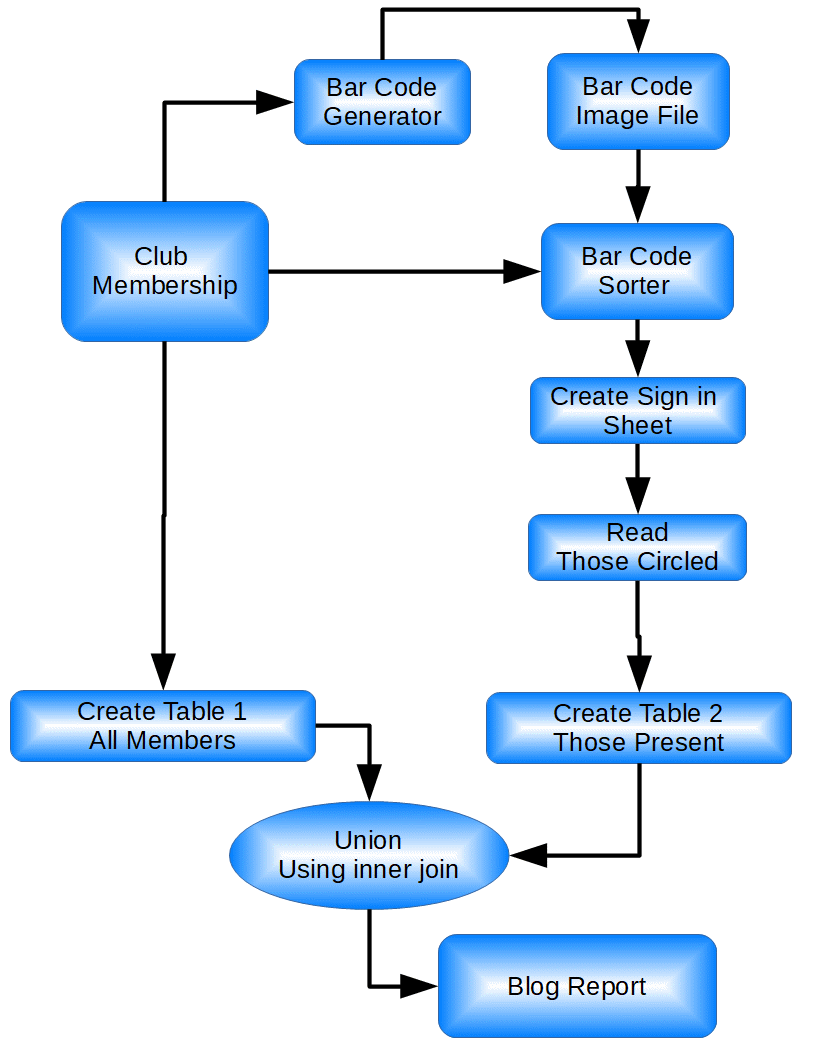
Bar codes are a natural for the club attendance. Each ham has a unique identifier. It is his or her call sign. Plus, we have a well maintained and accessible database that includes various pieces of information about its members. So like the supermarkets, it is quite feasible to marry the bar code read from the attendance sheet to the club’s database to produce a report which can then be published on the blog.
As with most things, the devil is in the detail, and there are plenty of details. Fortunately, bar code generation software is readily available for free, and hand held scanners have come way down in price. Database software is also available free. From these components a system was put together. The monthly workflow follows: